

I’ve typed up a couple of blog posts in the past few weeks but have all left them to rot in my drafts because either A) they felt way too negative (anime fans are making me disappointed) or B) they became nothing posts (mid month anime update where I’ve watched NOTHING). With that status update gone, I’ve honestly not been perusing much individual anime as so much as I’ve been going back to the “anime I really enjoyed but stopped watching” well and found myself staring into the depths of Gintama. One of my first blog posts contained a little aside about how much I loved Gintama and adored the humor and comedic sensibilities of it all. That’s, as any Gintama fan will tell you is only one facet of why it is so beloved because Gintama is more than fourth wall breaking absurdity and anime references; it’s also a show that has more heart than it lets on.
EPISODES 86 AND 87 OF GINTAMA MADE ME CRY AT WORK
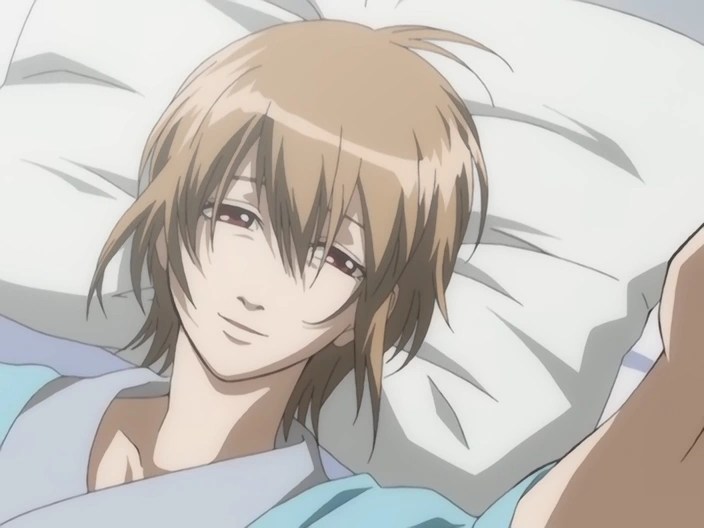
For the uninitiated, Gintama is a science fiction comedy that takes place in an alternate future Japan where aliens known as the Amanto have made contact and the shogun has essentially ceded control to said aliens which stripped Japan of its real self governing capabilities. Japan still has a police system in the form of the Shinsengumi but Japan has a vastly changed society. Our main character is a former rebel samurai named Gintoki Sanada who works odd jobs alongside friends Shinpachi and Kagura to make ends meet which usually leads to outrageously absurd hijinks like killing monsters to hunt for the gold balls they drop or stopping a friend marrying a gorilla alien princess. It makes sense in context of course. The show normally is a joke a minute affair where nothing is of consequence and we’re just along for a good time. That is, of course, until Gintama smashes the plot button as it will from time to time and everything gets serious.
Up to the point of episode 86 and 87 (which I’ll be using as my main point of discussions so SPOILERS AHEAD), Gintama has indulged in a couple of serious arcs like the Benizakura arc where main character Gintoki had to prevent a powerful weapon known as the Benizakura from falling into malicious hands. With that, Gintama had proved that there was indeed a more serious soul (a silver serious soul some might even say) underneath the sometimes crass jokes about poop and natto flinging BDSM ninja. The characters were not just vehicles for jokes but rather people who could find themselves in humorous scenarios as much as they could find them in dire ones. Gintama almost seemed to use that arc as attempt to show how drama could very well be a side effect of drama and vice versa in a world of changing circumstances like a dramatic upheaval of power. The point being, Gintama had declared that we will be serious sometimes and you’ll just have to embrace this which I think most viewers gladly did.

Enter episode 86: an episode that seemingly starts off as another humorous but mundane episode where characters are given backstory as the jokes pile on one after another which is common structure for Gintama at this point. A member of the Shinsengumi, Sougo Okita, has his sister Mitsuba arrive to announce her marriage and catch up with her brother and his compatriots of the Shinsengumi who were once childhood friends of her own. Mitsuba is concerned for Sougo and his well being so Sougo enlists Gintoki as a fake “best friend” to attest to how well Sougo is doing as a member of the Shinsengumi. When the trio eventually head home, the subject of Toushirou Hijikata, the Shinsengumi vice captain and childhood friend of Mitsuba, is broached and Souga leaves the conversation in apparent rage. Mitsuba explains to Gintoki how after their parents perished she was left to take care of Souga and seemingly spoiled him leaving him to be quite selfish. Hijikata himself then appears after a mission tailing a weapon smuggler and Mitsuba faints which reveals to us the audience that she has a life threatening lung disease. Drama, it seems, has ensued.
The gang of Gintoki, Souga, Hijikata, and a couple other members of the Shinsengumi all head to the hospital to monitor her condition and Hijikata departs to continue his mission after a few flashbacks showing how Mitsuba and he seemingly shared a fondness for each other. Hijikata rejected her when he departed with his Souga and his hometown friends hoping Mitsuba will find a man who will treat her well and “be normal”. Unfortunately, Hijikata’s wishes will be left unfulfilled as Mitsuba’s fiancé is, in fact, the weapon smuggler he’s been pursuing. When Hijikata arrives to take down said fiancé, the fiancé announced that he only wanted to marry Mitsuba for the connections to the Shinsengumi she offered by being Souga’s brother and loved her only for the profits she would incur him. Hijikata is eventually overwhelmed in combat by an onslaught of soldiers but the gang eventually arrive to finish the fight by teaming up with him. There’s a hugely wicked ending sequence where Gintoki, Hijikata and Souga team up to take out the fiancé who is attempted to escape with Souga in particular getting a tremendously badass moment when he bisects the car carrying the fleeing fiancé. Our crew rushes back the hospital but Mitsuba’s time is officially running out and Souga reunites with his sister to apologize for his life of selfishness and depriving her of what she really wanted like Hijikata. Mitsuba, obviously, rejects this notion and proclaims how proud she is of him before passing away. As her mourns, Gintoki and Hijikata are shown separately enjoying bags of very spicy senbei that Mitsuba loved ending episode 87. I, unfortunately, at this point was having a disgustingly large sob at work and had to excuse myself from my lunch to my car.
BUT WHAT DOES IT MEAN THOUGH
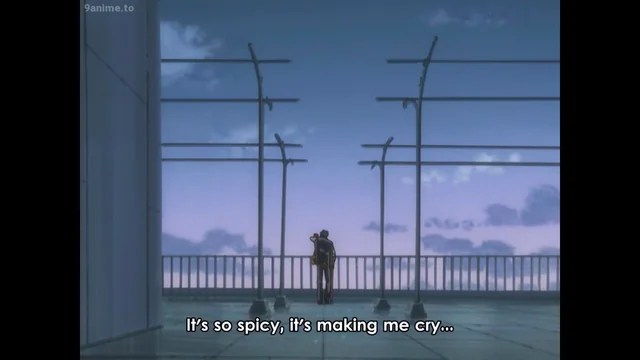
As you can tell from the above picture, we have one of those classic “I’m not crying because I’m sad” moments a la Roy Mustang and his “it’s a terrible day for rain” moment. Hijikata is eating his super spicy senbei and using it as an out for his tears. It’s a real crowd displeaser if I have to say anything about it because it only instills MORE anguish in me and I cry harder. Crying is, for sure, a sad event but the act of refusing to cry and holding back tears is an even bigger tragedy. Refusing to allow yourself the pangs of sadness shows a front that must be put on for yourself or others showing how you’re not given the luxury of releasing yourself to emotion. This brings me to the crux of why these emotional episodes within Gintama strike so much harder than they should. Sure, the premise of episodes 86 and 87 are hardly original even by the time they aired originally in 2007. “Loved one acts selfish and regrets how someone they love had to sacrifice for them and gets one final moment as they leave the world where it’s revealed they’re forgive” is not a new concept but maybe typing it out like that could be. A silly show of the magnitude that Gintama strives for, however, is what introduces a new spin to the whole thing. A comedy program doing a “very special episode” is also not a fresh invention by any means but this very real reminder that our characters are grounded humans is what freshens up this concept.
Our cast does not revel in melancholy. 87 episodes in and we only know so much about our main character Gintoki’s real past outside of how he was a samurai at one point. Even at this point, the Shinsengumi themselves had remained a very overpowering presence in Gintama as well. Souga Okita was nothing more than a sadist who delighted in inflicting agony on Hijikata in particular. With these episodes, we can visualize that there is some truth in the kernels of comedy. Okita may be written for comedic effect but through his sister we see now that he could have been acting out on behalf of his sister. Hijikata once rejected her leaving us to perceive how Okita could be deferring her perceived sorrow onto Hijikata with his sadism. Now a facet of his personality that was previously purely a joke now is a harbinger of deeper misery within. What makes Gintama so special to me at almost 100 episodes in is that the drama always manages to feed into the comedy in unsuspecting ways. Our characters are comically written but is this for jokes or are they actually real and breathing suffering beneath it all? Using comedy as a way to cope is a very real thing as I will gladly attest. I don’t know how many “my dad died” jokes I can make before I start sobbing but I have to because I’m not sure how to cope myself. It just makes me ruminate on how weirdly grounded Gintama actually is underneath it all. I know other anime do this “better” and with greater skill but Gintama never stops managing to impress me how skillfully it binds the comedy with drama thus feeding each other with one another. It’s an amazing show. Maybe I’ll finish it this year. Maybe.
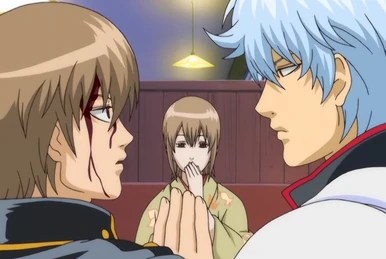
Go listen to my podcast, The Anime Brothers Podcast (episode 201 and onward), if you want to! I won’t force you but if you want more inane anime rambling courtesy of yours truly then that’s where it’ll be. Tell me all about some of your favorite comedy-drama anime while you’re at it too if you want! I’d love to read from you.

 Animisery - A Blog About Living Miserably with Anime (Among Other Things)
Leave a comment